

Designing for digital wellbeing: Why standards matter for children’s digital futures
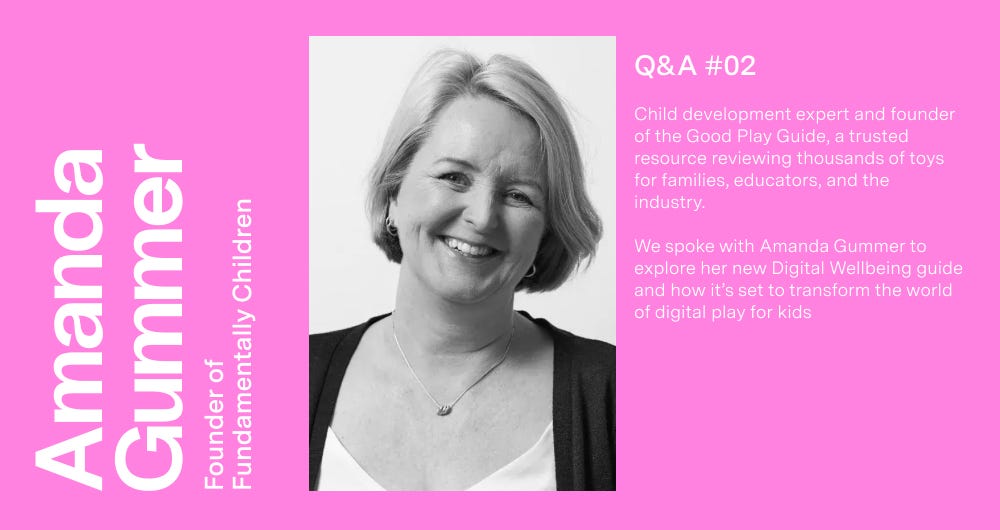
A conversation with Dr Amanda Gummer: Child Psychologist and Founder of the Good Play Guide.

Digital technologies are now woven into the everyday fabric of childhood - from learning apps and TV platforms to connected toys and games that update by the hour. Yet while children’s digital lives have transformed, the frameworks that guide quality, safety and wellbeing have struggled to keep pace.
To understand what it means to create digital experiences that truly help children thrive, we spoke with Dr Amanda Gummer, Neuropsychologist, founder of the Good Play Guide, and a long-time advocate for evidence-based standards in children’s play and digital products. With more than two decades of experience spanning research, toy testing, accreditation, and international frameworks, she is now leading the development of a new Digital Wellbeing Framework - an ambitious effort to certify digital products that support children’s development in meaningful, healthy ways.
In this conversation, Amanda shares her personal journey, her vision for the new framework, and why raising the bar for children’s digital experiences matters more than ever.
You’ve worked across psychology, education, play, and industry. What experiences shaped your path into this work?
Amanda’s path has always centred on the impact of play. After completing a PhD in Clinical Neuropsychology, her early work with families in crisis showed her how playful connection could rebuild confidence and stability for children. Later, in Hong Kong, she tutored students with special needs and created theatre-based workshops, seeing again how play unlocked learning where traditional methods couldn’t.
When she returned to the UK with two young children, she began lecturing in child development. A request from one of her father’s toy-industry contacts to run a focus group changed everything. Instead of simply observing children, she interpreted their behaviour through developmental principles - explaining why certain features supported specific skills and how toys could be improved. That approach immediately stood out, and one project quickly led to another. Over the next 25 years, this grew into the Good Play Guide, now a trusted resource with thousands of products reviewed.

Many people know the Good Play Guide, but fewer know about your accreditation work. How did that develop?
Amanda shared that the Guide’s familiar play ratings - fun, skills development, and ease of use - gradually led to bigger questions from industry: What does good look like? How do we benchmark quality?
This culminated in her team being commissioned to create a range of evidence-based frameworks, from standards for children’s activity providers to the US Toy Association’s STEAM accreditation programme. These frameworks combine developmental science with practical criteria, giving organisations clear pathways to improve their offerings and demonstrate quality.
With this experience, it became increasingly clear that the digital world needed its own equivalent - a way to distinguish products that meaningfully support children’s wellbeing from the thousands of offerings that simply capture attention.
Tell us about your new Digital Wellbeing Framework. Why this, and why now?
Amanda’s answer was disarmingly simple: because children’s digital lives are growing exponentially, and quality is becoming harder and harder to find.
“We heard a staggering statistic recently - that something like 13 years’ worth of TikTok content is produced every day. And that’s just one platform. Add YouTube, Roblox, and the app stores… There is just so much out there that we need a way to highlight high-quality, developmentally beneficial content.”
The Framework has been brewing for several years, but only became possible when Amanda’s team secured Innovate UK funding. Their ambition is two-fold:
Give families a clear, trusted mark that a digital product has been assessed for its contribution to children’s wellbeing.
Influence discovery systems, from app stores to streaming platforms, so high-quality products become easier to find.
This requires working at ecosystem level - from small developers to major players like Google, Amazon and Netflix - which is why Amanda has convened cross-industry working groups to shape the standards collaboratively.
Digital wellbeing, she stresses, isn’t about “good versus bad” screen time. It’s about positioning digital experiences within a balanced play ecosystem, making the developmental value of digital products more discoverable, and ensuring the design reflects what children actually need to thrive.

From a developer’s perspective, what kinds of factors might the certification look at?
Amanda emphasised that the framework won’t be punitive - its purpose is to raise standards, not shut creators out. But there will be several layers:
1. Compliance and safety
Products will need to meet core requirements around data protection (GDPR, COPPA), age appropriateness, and transparency. This includes making clear how data is used, how AI is involved, and what safeguards exist.
2. Child development and wellbeing
Building on the Good Play Guide’s long-standing criteria, the framework will examine how a product supports learning, resilience, creativity, social connection, or other developmental outcomes.
3. Design functionality and risks
This is where the working groups will play a major role. Open questions include:
How should in-app purchases be handled?
What are acceptable versus non-acceptable forms of advertising?
How do we evaluate interpersonal features such as chat or online connections?
What does safe, transparent AI look like within a children’s product?
4. Organisational capability
Because digital content changes constantly, certification won’t be tied solely to a one-off product check. Much like other frameworks the team has built, it will likely evaluate the competence, training and processes behind the product - ensuring teams are equipped to maintain standards over time.
And what about AI? How will the framework address that?
Amanda sees AI not as a separate category, but as a design consideration that cuts across all digital products.
“The presence or absence of AI isn’t the issue - it’s how it’s used. What matters is whether AI is helping children thrive or introducing risks, and whether families understand what the system is doing.”
She expects AI-related criteria to sit largely within compliance and transparency:
Is the use of AI clearly communicated?
What data is being collected and why?
What guardrails exist around interactions, content generation, or personalisation?
The key is future-proofing the framework so it remains relevant as technologies evolve.
Will organisations be able to get support in preparing for accreditation?
Yes - while the framework is still being built, Amanda anticipates offering preparation support, just as her team does for other accreditation programmes. The goal is to help organisations make meaningful improvements, not catch them out.

Are there digital products you consider particularly strong examples of child-centred design?
Amanda hesitates to single products out - not because there are too few, but because there are so many she hasn’t yet seen. But a few stand out:
Osmo, for the way it blends physical and digital play.
Tonies, which offers screen-free storytelling with an emphasis on imagination.
CBeebies, which she considers a model for high-quality, age-appropriate, accessible digital content.
These examples remind her - and all of us - that digital technologies can support children’s thriving when designed with care.
Closing reflections ✨
What emerged most strongly from our conversation is Amanda’s belief that digital wellbeing isn’t about restricting children, nor about chasing novelty for its own sake. It’s about designing intentionally for their growth - with evidence, empathy, and a clear understanding of how children develop.
In an era where the volume of digital content is growing exponentially, this new Digital Wellbeing Framework represents a rare opportunity: to shape a shared standard of quality, to champion products rooted in genuine developmental benefit, and to give families clearer guidance in a crowded digital landscape.
Above all, Amanda’s work reminds us that the design of children’s digital environments is not just a technical challenge. It’s a responsibility - one that calls for collective action, deep expertise, and an unwavering commitment to helping children thrive.

This highlights why quality standards matter as much as access in children’s digital lives. The focus on transparency, development, and ongoing accountability is well aligned with child wellbeing research.